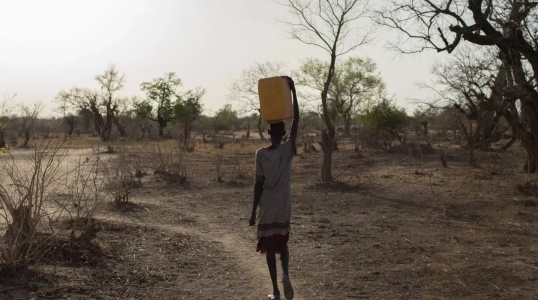
Across Sudan, conflict has forced families from their homes and into uncertain futures. In Zalingei, (a town in the Darfur region of Western Sudan), the lives of three displaced people reveal what survival looks like day to day: the search for food, water, shelter, and healthcare while trying to hold on to stability, dignity, and hope.
Lives Intertwined by Displacement
In Zalingei, displacement is not one story but many, bound together by loss, uncertainty, and the daily work of survival. Families who fled from Al Khartoum, Omdurman, Al-Fasher, and other conflict-affected areas in Sudan, carry different memories, but they now share the same fragile reality: rebuilding their lives in gathering sites and shelter centres, with too little food, shelter, income, and healthcare to go around.
Tagrid’s Journey to Safety
Tagrid with community worker
Tagrid and her family fled Omdurman after escalating clashes between armed groups made their home unsafe. They left behind the life they knew and set out in search of safety, only to meet more hardship along the way. They were injured in a road accident during the journey, and while still trying to reach a place where they could receive care, they were robbed of the few belongings they had left. By the time they arrived in Zalingei, the family had lost not only their home and income, but also the sense of stability that once held their lives together. Now living in a shelter centre, they spend each day searching for food, water, and basic medical support while trying to protect a future for their children.
Suliman and the Burden of Daily Survival
Suliman in a gathering area in Central Darfur
Elsewhere in Zalingei, Suliman describes a different path to the same uncertainty. A father displaced from Al-Fasher, he now lives in the UNAMID gathering area in the Central Darfur site, far from the home he once knew. As head of his household, he looks for work, but it is scarce and irregular, some days he finds temporary labour in the market, other days there is nothing. The market is itself a burden to reach when transport costs are steep, and food depends on what he can earn in a day. Shelter remains inadequate, water arrives through humanitarian support, and health services come only periodically through a mobile clinic. For his family, every day is shaped by waiting, stretching limited resources, and hoping that the next day will be a little easier.
Ibrahim’s Life with Displacement and Disability
Ibrahim with a community worker in Zalingei
For Ibrahim, a young man living in the same gathering area, displacement has been compounded by disability. Before the conflict, he worked with automotive air conditioning and refrigeration equipment in Al Khartoum. Now he is unemployed, uprooted, and dependent on assistance. living with his wife, young child, and mother. His mobility limitations make even ordinary routines more difficult. Much of his day is spent sitting near his shelter, talking with relatives and waiting for the possibility of work; when he can, he travels to the market to try to earn a little money for his family. But his movement is restricted, and accessing services without support is difficult. For families like his, survival depends not only on resilience, but on whether help can reach them where they are.
The Difference Humanitarian Support Makes
Action Against Hunger community health training
Across these different lives, the same needs appear again: healthcare close enough to reach, medicines available when needed, nutrition support for children, safe water, food assistance, and a pathway back to dignity. In all three stories, support from Action Against Hunger has made a meaningful difference. Mobile health and nutrition services have helped families who previously had little or no access to care. Parents speak of children receiving treatment for malnutrition, of illnesses being attended to earlier, and of no longer travelling long distances in search of basic medical help. Even where services remain limited, the presence of care has reduced some of the risks that displacement creates.
What Still Remains Out of Reach
Yet these interviews also show how fragile that progress is. Medicines are not always enough for everyone who needs them, and mobile services cannot replace a permanent health facility. Food insecurity continues, education has been interrupted and livelihoods have collapsed. Families who once worked and supported themselves now depend on aid, irregular labour, or the hope that a weekly visit from a clinic can carry them through another stretch of uncertainty.
Holding On to Hope
Still, hope runs through all three stories. The mother in the shelter centre wants stability, education for her children, and the chance to rebuild her family’s life. The father in the gathering area hopes for stronger, more sustainable services and a health system that offers enough medicine and proper examinations for everyone. The young man living with disability hopes that health, nutrition, water, and food support will continue so that families like his are not left behind. Their hopes are practical, urgent, and deeply human: safety, dignity, work, education, and the ability to care for those they love.
Together, their stories form a single picture of displacement in Zalingei. It is a picture of families uprooted by violence, navigating hardship that did not end when they escaped the front lines. But it is also a picture of resilience: of parents continuing to provide, of young people adapting to a harsher reality, and of communities holding on while humanitarian support helps keep essential services within reach. In that fragile space between crisis and recovery, survival is made possible not by one dramatic moment, but by the steady presence of care, access, and hope.